Search This Blog

11 August 2024

Accuracy Limit Factor (ALF) of Current Transformer

Accuracy Limit Factor (ALF) is the ratio of the rated accuracy limit primary current to the rated primary current. This factor is critical for ensuring accurate relay operation during fault conditions, safeguarding the integrity of the protective system.

ALF is used for protection class CTs. For metering class CTs there is similar term called Instrument security factor (ISF).

In simple terms, it is the number times rated current that the stated accuracy is good up to. For example, if a CT has rating of 5P20, it will have 5% accuracy upto 20 ALF. Meaning the CT will maintain 5% accuracy up to 20 times rated current with rated burden applied. In practice, it means that the CT won't saturate at upto 20 times rated current with rated burden applied. 

Equivalent circuit of CT:

IP = Primary current

IS = Secondary current

VS = Secondary voltage

ZE = Exciting impedance

IE = Exciting current

RS = Secondary resistance

XL = Leakage reactance

ZB = Burden impedance 

Effect of burden on ALF: ALF is specified for a certain burden. If actual burden is different from rated burden, ALF will change as below:

In practise, the actual accuracy limit factor differs from the rated accuracy limit factor (Fn) and is proportional to the ratio of the rated CT burden and the actual CT burden.

ALF at actual burden = ALF at rated burden x (Rated burden / Actual burden)

* Internal secondary winding resistance of CT to be added for calculating burden.

For example, for a CT with rated burden 20VA and ALF 5, if actual burden is 10VA, ALF will be =5 x (20/10) =10. I.e. accuracy will be maintained upto 10 times rated current.

29 December 2023

End Fault Protection in bus bar relays

Bus bar protection is generally differential protection for which zone of protection is defined by location of CTs. However, location of isolation is defined by CBs. The area between CB and CT is always an issue for protection schemes. 


In above image, CT location in Bay-1 is on line side and CT location in Bay-2 is on bus side. It has been done intentionally to discuss both cases. However, in actual practice mostly CTs are placed on line side. In old schemes, without end fault protection enabled, this area is taken care by Breker Failure Relays with a time delay around 200ms. 
For Numerical bus bar relays, end fault protection is an additional feature to take care of the area between CB and CT.

Bay-1: CT location on line side

Case 1.1 When CB is open: Current flowing through 1CT (feed from remote end) is not included in busbar differential relay calculations. Therefore, busbar relay will not operate for fault between 152CB and 1CT. End fault protection relay has one additional over current element, which will operate in this condition when current through 1CT is above set value. This will send direct trip command to remote end through communication channel so that fault is cleared without any time delay.

Case 1.2 When CB is closed: Current flowing through 1CT is included in busbar differential relay calculations. Therefore, busbar relay will operate for fault between 152CB and 1CT. Depending on scheme, Busbar protection will send direct trip command to remote end through communication channel so that fault is cleared without any time delay or end fault protection will operate and send direct trip after CB is open.

Bay-2: CT location on bus side

Case 2.1 When CB is open: Current flowing through 2CT (feed from local end) is not included in busbar differential relay calculations. This causes extension of bus bar protection zone upto CB. Therefore, busbar relay will operate for fault between 252CB and 2CT. 

Case 2.2 When CB is closed: Current flowing through 2CT is included in busbar differential relay calculations. Since area between 252CB and 2CT is outside differential zone, busbar relay will not operate for this fault. This fault will be detected by line protection. After opening of CB, End fault protection relay will come in picture as mentioned in Case 2.1.

27 July 2022

Over current and earth fault protection

Over current protection and earth fault is simple protection. Being low cost protection it is widely used across all levels. For lower voltage levels it is main protection, and for higher voltage levels it is used as backup protection. The reason being this protection does not have clear boundaries of protection.

Over current protection is for phase current and earth fault is for neutral current (residual current). The characteristics for both protections are same.


This protection is of two types: definite time (DT) or inverse definite minimum time (IDMT).

Definite Time (DT): In this type, protection will start when current reaches a set value, and protection will operate after a set time. For example, we for a transformer having maximum through fault current of 100A we can set DT protection 110A with time delay 100ms. In this way protection will operate in case of faults inside transformer only. For faults on downstream current will be less than 100A and protection will not operate.

Inverse Definite Minimum Time (IDMT): In this type, protection will start when current reaches a set value, and operating time of protection will depend on the level of current. If current is very high compared to set value, protection will operate fast. If current is slightly high from set value, relay will take more time to operate. In this way, a curve can be drawn between current and time for each relay. There are standard curves for which relays are designed. User can select from these curves as per requirement. For mechanical relays these curves are fixed as per design. However, in case of static / numerical relay curve can be selected form settings of relay.


For example, we have set relay in IDMT standard inverse for a transformer. Full load current of the transformer is 100A, and we have set IDMT start at 120A. The relay will start when current increases beyond 120A. If the current is 1200A, which means 10 times of set value. For 10 times current, the operating time is 2s (from curve). There is another setting called Time multiplier setting (TMS), say it is set at 0.4 for this transformer. The operating time of relay will be 0.8s.

If fault current is 240A, which means double of set value. For double current the operating time is 10s. The operating time of relay will be 4s.

In this way, relay will operate in 800ms for fault current of 1200A and in 4 sec for fault current of 240A

The operating time can be calculated as per below (IEC):

Standard inverse: t = TMS x 0.14 / [(Ir^0.02) – 1]

Very inverse: t = TMS x 13.5 / [Ir – 1]

Extremely inverse: t = TMS x 80 / [(Ir^2) – 1]


13 March 2022

Time synchronization

Introduction: After any disturbance in power system, analysis for cause of disturbance requires sequential events from relevant protection and control devices. Therefore, all numerical IEDs (relays and controllers) needs to be time synchronized for proper sequence of events in chronological order. 

Generally IEDs are time synchronized by one of the following method:
  1. Pulse Per Minute (PPM)
  2. Inter-range instrumentation group timecode-B (IRIG-B)
  3. Simple Network Time Protocol (SNTP)
  4. Precision Time Protocol (PTP)
PPM: Time of the relay has to be set once manually, only seconds and milliseconds will be reset to 00.000 after receiving pulse from time synchronization equipment. It is simplest way of time synchronization. Large number of relays can be synchronized by connecting in parallel. Its accuracy depends on accuracy of internal clock as after synchronization it has to run on internal clock for one minute untill next pulse is received. Being obsolete system it is rarely used these days.

IRIG-B: It is standard format for transferring time information. Information can contains data for day of year, Hours, Minutes, Seconds and milliseconds.Data is transmitted by moduling on 1KHz sine wave through co-axial cable. Accuracy of microsecond level can be achieved. 

SNTP: It is time synchronization using Local Area Network (LAN) system. GPS equipment works as server and sends time information, which contains complete data Year, Month, day, Hours, Minutes, Seconds and milliseconds. All the IEDs get time information from server and time is synchronized. Its accuracy is low as delay in network components is not compensated. Accuracy of millisecond level can be achieved.

PTP: It is used where more accuracy is required than provided by SNTP. In PTP delay in network components is calculated by system and compensated by modifying time stamps. In this way, accuracy of nanosecond level can be achieved.

Controlled switching

Introduction: In AC system, magnitude of current and voltage signal are always varying in time domain. Whenever opening command is given to a circuit breaker (CB), there may be some current flowing depending on the instant of contact separation. Magnitude of this current will be different for three phases, as they will be passing through different position (angle) at any point.

CB will quench the arc at next current zero. The duration of arc will depend on position of current wave at the moment of separation. As we know, longer the duration of arc, larger the heat generated and larger the contact deterioration. Therefore, best time of opening instant will be just before the current zero to reduce arcing time. Opening at exact current zero will not work due to the reason that the speed of contacts will be slow and recovery voltage across contacts will be larger than dielectric strength gained. This will result in to restrike across contacts and arc will be quenched at next current zero (another 10ms for 50Hz system). Further there may be open time variation due to mechanical reasons in CB for each operation.

Controlled Switching Device (CSD): EHV class CBs, which are electrically ganged, have different operating mechanism for each CB pole. CSD device is used to operate all three CB poles at different times so that arcing in each phase is minimum. 


For proper operation of CSD, CB mechanical opening time for each phase is to be measured and entered in to CSD relay. As shown in image below, delay of 3.3ms (for 50Hz system) is to be provided for achieving opening of all phase just before current zero.


CSD is used only for manual operation due to added delay in opening. Protection trip will be issued to CB directly without and controlled switching.

CSD is used mainly in following applications:
  1. Reactor opening: to avoid current chopping
  2. Transformer charging: to avoid high inrush current
  3. Capacitor charging: to avoid high inrush current
  4. Transmission line charging: to avoid switching voltage surges

Floating DC system and DC earth fault relay

Introduction: DC supply is widely used as auxilliary supply for control and protection system. For larger systems 110V or 220V DC supply is used. For reliability both positive and negative terminals of DC supply are isolated from ground. This is system is called floating DC system.  

Floating DC system has advantage that single earth fault will not cause any outage. Second earth fault may blow the fuse or maloperation of protection. 

DC earth fault relay: For identification of earth faults in early stages, sensative DC earth fault relay is used. 

DC earth fault relay is connected to midpoint of two high value resistors (~ 20kΩ). In normal condition as there will be no path for current to earth, there will be no current in relay element. During a DC earth fault in +ve or -ve terminal, current will flow in to earth by completing return path through DC earth fault relay element. Typical setting for DC earth fault relay is ~ 5mA.

This will cause operation of DC earth fault relay and give alarm to operator. Earth fault can be identified and rectified by maintenance staff before second earth fault. As high value resistance is used in earth fault circuit, fault current will be very low and identification of exact feeder and loaction of fault is difficult. Following methods are generally used for identification of location:
  1. Switching off feeders one by one.
  2. Using DC earth fault locator instrument, which inject low voltage low frequency signal of ~5Hz in DC system. Faulty feeder is identified by measuring leakage current using tuned clamp on meters.

06 March 2022

Interlocking schemes

Introduction: In power system following switchgears are used for operation purpose:

  1. Circuit Breaker (CB): It has capability to close or open electric circuits under load or fault conditions. 
  2. Disconnector (or Isolator): It can close or open electric circuits under no load condition.
  3. Earth switch: It is used to earth primary conductors for maintenance purposes.

Above description leads to following requirements:

  1. CB can be opened or closed on no load or full load or fault condition. Therefore, no check is required for disconnector or earth switch status. However, for safety and security of grid, synchronization check is carried out in grids.
  2. Disconnector should be operated only when load current is not flowing, i.e. CB should be open. Further, if earth switch is closed, closing of disconnector may cause fault. Therefore, before closing disconnector, associated earth switch status needs to be checked.
  3. Earth switch should be operated only when primary conductor is already de-energized. Therefore, status of associated disconnectors needs to be checked. In case of long transmission lines, that may be charged from remote end, status of remote end switchgear may not be available. In this case presence of voltage can be checked for interlocking.

For example, let's take a simple single bus bar scheme:


  • 189A can be operated when: 152 is open, Bus earth switch is open
  • 189B can be operated when: 152 is open
  • 289A can be operated when: 252 is open, Bus earth switch is open
  • 289B can be operated when: 252 is open
  • Bus earth switch can be operated when: 189A is open, 289A is open

For one and half breaker scheme:


Disconnector 389A can be operated when:
  • CB 352 is open
  • Earth switch 389AE and 389BE is open
  • Bus-2 Earth switch is open
Disconnector 389B can be operated when:
  • CB 352 is open
  • Earth switch 389AE and 389BE is open
Disconnector 389L can be operated when:
  • CB 352 & CB 252 is open
  • Earth switch 389LE is open
ES 389AE can be operated when:
  • Disconnector 389A & 389B is open
ES 389BE can be operated when:
  • Disconnector 389A & 389B is open
ES 389LE can be operated when:
  • Disconnector 389L should be open
  • There should be no voltage in line

23 January 2022

VT supervision

Introduction: For protection relays, analogue inputs are connected from Current Transformers (CT) and Voltage Transformers (VT). VT is a voltage source, any short circuit in wiring will cause heavy current to flow in VT winding. This may result in failure of VT. Therefore, Connection from VT is always with fuse or MCB to take care of short circuit / overload.

Now it is evident that in case of fuse failure, relay will not get any voltage from VT. Some of the protections may see this as abnormal condition in system and may cause unwanted trip or may not trip in actual fault. For example:

  1. Distance relays measure Impedance from Voltage and current (Z = V/I). If there is no voltage (V=0), Z will also be Zero. This will cause trip of distance protection.
  2. Directional Overcurrent relay derives direction by comparing angle of voltage with current. If there is no voltage, it can not measure its angle. Therefore, it will not operate in case of actual fault.
Absence of voltage or lower voltage to relay may be due to one of the following reason:

  1. Actual fault on primary side of power system, which has caused voltage to dip. One disturbance record for this condition with B-N fault is given below. We can see presence of VN (3V0) with significant IN (3I0).

  2. No actual fault on primary side, only secondary fuse fail. One disturbance record for this condition with C-phase fuse failure is given below. We can see presence of VN (3V0) without any significant IN (3I0).

It is important for protection relays to differentiate between above two conditions and declare VT fuse fail only when there is no fault in primary side. VT fuse fail condition leads to blocking of certain protection functions and generation of alarm to operator.

Method of detection: VT fuse fail may be classified in two types:

  1. Single phase VT fuse fail, when fuse is used in VT secondary circuit and it has blown due to short circuit.
  2. Three phase VT fuse fail, when MCB is used in VT secondary circuit and it has tripped. There may be another case when VT selection is used and VT selection relay has failed to operate.  

Single phase VT fuse fail: Its detection is easy and reliable. In case of actual single phase fault, voltage will decrease and current will increase for that phase, ie. there will be zero sequence current and zero sequence voltage present in system. 

However, in case of VT fuse fail, currents will remain same and only voltage will be decreased. Most of the relays detect it by presence of Zero sequence voltage without presence of Zero sequence current in system. In some case Negative sequence voltage and Negative sequence current is used for detection.

Three phase VT fuse fail: It is a little unreliable and works to some extent. Due to absence of all three phases there will not be any zero sequence or negative sequence voltage in the system. 

It can be detected by change in voltages without any change in currents by comparing with previous cycles values (ΔV and ΔI). But in case three phase fuse fail condition is persisting, and current goes below a certail level, due to load variation. Relay may detect it as dead line condition (no voltage and no current). This will reset three phase VT fuse fail condition. Now sudden rise of current can cause trip of relay. Therefore, three phase fuse fail is a little unreliable. 

Or, relay can detect MCB trip through auxilliary contact of MCB, if MCB is used in secondary circuit.


16 January 2022

Add-on stabalization technique in Bus Bar protection

 Introduction: In earlier post we have discussed about Bus bar differential protection.

For Low impdance bus bar protections, different manuafacturer use different algorithm to avoid mal-operation of relay during CT saturation.

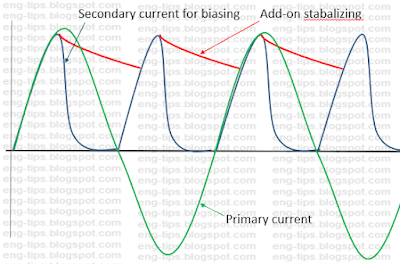
Add-on stabalization technique: One of the method is use of Add-on stabalization technique for detecting internal / external faults. Due to sharp reduction of current of one of the CT due to CT saturation, biasing current will reduce sharply, and relay may issue trip. 


With add-on stabilization, biasing current reduces at a slower rate. After half cycle current appears again in CT secondary circuit and biasing current will increase again as per actual. In this way, differential relay remain stable in case of CT saturation.

Phase comparison technique in Bus Bar protection

Introduction: In earlier post we have discussed about Bus bar differential protection.

For Low impdance bus bar protections, different manuafacturer use different algorithm to avoid mal-operation of relay during CT saturation

Phase comparison technique: One of the method is use of Phase comparison technique for detecting internal / external faults. Phase comparison function compares the phase-angles of the fundamental components of all the feeder currents.

During a through-fault, at least one of the currents is ~180° out of phase with the others. In case of CT saturation its magnitude may be lower but relay can compare its angle to distinguish internal fault from external fault. 

During internal fault of bus bar, currents from all feeders will flow towars busbar. This means, phase angle of all currents will be nearly same.

If the phase-angles of all the feeder currents of a protection zone lie within a band of ~74° (typical value), the phase comparison function decides that there is an internal fault.

For proper operation, it is necessary to exclude feeders conducting very little or no current from the comparison to prevent noise generated by them.

A minimum current is therefore determined below which a feeder is excluded from the phase comparison. Typical settings are 0.8 IN for the phase currents and 0.25 IN for the neutral current.

Tripping only takes place if the differential current and the stability factor (Slope) are both above their pick-up settings and the phase difference between the currents is less than setting.


Bus bar differential protection

Introduction: Bus bar is important element in a power system due to following reasons:

  1. Fault current is higher for bus bar faults, as every feeder will contribute in fault current and bus bar impedance is very low.
  2. Bus bar fault may lead to outage of many feeders, depending on bus bar scheme. Mal-operation in case of out of zone fault will also cause un-necessary outage. Therefore, generally trip decision is taken after confirmation by two different components in bus bar protection.
  3. Non-operation of busbar protection in case of actual fault is very dangerous for equipment, persons working in system and power system itself. It will lead to delayed fault clearance and impact larger area. To avoid this redundant bus bar protection schemes are used for important installations.
  4. Bus bar has to compare currents of all feeders connected to it, there is requirement of all CTs having similar characteristics to avoid mal-operations in case of through faults.
  5. Being smaller sections, faults are considered rare for bus bars. As bus bar protection cost is higher, generally bus bar protection is not used for smaller systems.
Principle of operation: Differential protection works on the principle of Kirchhoff's current law, which states - "The current flowing into a node (or a junction) must be equal to the current flowing out of it" or equivalently "The vector sum of currents in a network of conductors meeting at a point is zero."

Bus bar can be considered as node, where all feeders are connected. The vector sum of all these currents shall be zero. 

For understanding we may consider one bus bar with two feeders.


Case-1: For out of zone fault, current through relay will be I1 - I2, which is zero. 


Case-2: For in zone fault, current through relay will be I1 + I2, which will have higher value depending on source behind Feeder-1 & Feeder-2.

The protection shown in this example will have following issues:
  1. It may trip for out of zone faults due to CT. Ratio error during heavy current
  2. Unstable due to saturation of CT magnetic circuit during heavy current
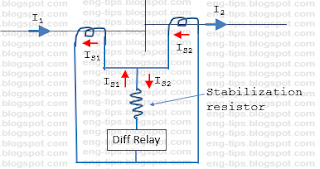
For avoiding this we have to increase stability of bus bar protection for these conditions. One solution would be to add one stabalization resistor in series of differential relay. It is similar to Transformer REF relay 


In this case impedance of bus bar protection is high due to series resistor, therefore protection is called high impedance differential protection. As all CTs are to be connected directly in parallel, all the CTs should have same CT ratio.

Second solution is to measure through fault current for each feeder and use this current for biasing element. It is similar to Transformer differential protection.


In this case impedance of bus bar protection is low, therefore protection is called low impedance differential protection. As every CT is connected directly to differential relay, relay has values of every individual feeder current. Relay calculates Differential and Biasing currents based on internal algorithm and settings adopted. 

IDifferential  = |I1 + I2 + ……. In|

IBias = |I1| + |I2| + ……. |In|

Stability factor k = IDifferential / IBias


There is a minimum value of Differential current, below which relay will never operate. Above this differential current, operation is decided by ratio of Differential current to Biasing current. For bus bar protection fault current levels are high, and CT saturation is expected to cause error in CT secondary currents. Different manufacturers use different techniques to take care CT saturation, some are discussed below:
Bus bar protection becomes more complicated when CT switching is possible, line in Double busbar scheme. 
Now, relay has to check which feeders are connected to bus bar through status of disconnectors. There may be discripancy in status due to problem of an auxilliary switch or when performing bus shifting in charged condition. Bus bar relay may see differential current due to time mismatch between actual position of disconnector and auxilliary switch of disconnector.

Additional Check zone is used in this case. Check zone calculates vector sum of all feeders in and out of a station, considering all bus bars as one bus bar, whithout any CT switching.
For double bus bar, Tripping is issued as below:
  • Bus Bar-1 : BB Zone-1 operated and Check Zone operated
  • Bus Bar-2 : BB Zone-2 operated and Check Zone operated

22 October 2021

Instrument Security Factor (ISF) of Current Transformer

Instrument security Factor (ISF) is used for specifying current limit, by which current will be delivered by a current transfprmer (CT) during fault conditions. 

ISF is used for metering class CTs. For protection class CTs, there is similar term called Accuracy Limit Factor (ALF).

Metering instruments like energy meters, transducers etc. are meant for measuring electrical quantities with high accuracy under normal operation. Measurement under fault condition is not required and insignificant due to short duration of faults. Metering instruments are designed to carry current upto a certain level. 

For example, an energy meter used with CT of 1000/1A ratio carries maximum 1A under full load. Therefore its input current carrying paths needs to be designed for current upto 150 to 200% of rated current (say 2A continuous) . For fault conditions, which will prevail for short duration, it should withstand upto 5A or 10A. But in case of severe fault of 40kA or 50kA on primary side, secondary current may go upto 40A or 50A. If meter is to be designed for such heavy currents its size and connections will be bulky. Its cost will go up and accuracy will go down. Therefore, CT core is designed to saturate at such heavy currents and maximum secondary current is specified as ISF.

ISF is ratio of rated instrument limit primary current to rated primary current. If ISF is specified as 5 for a 1000/1A CT, then CT metering core will saturate at 5000A primary and current in secondary will not go above 5A. Sometimes, auxiliary reactors are used to achieve ISF limit.

Equivalent circuit of CT:

IP = Primary current

IS = Secondary current

VS = Secondary voltage

ZE = Exciting impedance

IE = Exciting current

RS = Secondary resistance

XL = Leakage reactance

ZB = Burden impedance 

Effect of burden on ISF: ISF is specified for a certain burden. If actual burden is different from rated burden, ISF will change as below:

ISF at actual burden = ISF at rated burden x (Rated burden / Actual burden)

* Internal secondary winding resistance of CT to be added for calculating burden.

For example, for a CT with rated burden 20VA and ISF 5, if actual burden is 10VA, ISF will be =5 x (20/10) =10. I.e. maximum secondary current will be 10A.

22 August 2021

Resistance, Reactance and Impedance

Resistance: When electric current flows through a material there will always some opposition to this flow. Resistance (R) is measure of opposition to flow of electrical current. Resistance is measured in ohm (Ω). The resistance depends on resistivity (ρ), length (l) and area (a) of material:

  1. Length of material: Resistance is directly proportional to length of material. That’s why poor voltage conditions are observed in remote locations.
  2. Area of material: Resistance is inversely proportional to the area of material. That’s why we use thicker wires for heavy duty appliances.
  3. Resistivity of material: Resistivity is fundamental property of material by which it opposes flow of electric current. Resistivity of some of common materials at 20⁰C is given below:

Resistance will cause energy loss, which is equal to I2R. For transfer of electrical power from source to appliance, low losses are expected, therefore materials with lower resistivity are used as conductors like copper, aluminum etc. In some cases, these losses may be intentional. Like in heaters, I2R losses should be higher. Therefore, we use material with high resistivity like Nichrome etc. Rubber, Air and PVC are used for insulation material due to higher resistivity.

Resistance of a material is practically considered constant over a short working range of temperature. However, it varies with temperature due to change in resistivity.  For example resistivity of copper at 21⁰C will be 1.68 x 10-8 x (1 + 0.00404) Ωm.

Resistance will be same for DC as well as AC currents.   

Reactance (X): In AC systems, voltage and current are continuously varying due to sine wave form. Due to this, in addition to resistance, one more component opposes the flow of current called reactance (X). Reactance have two components, Capacitive reactance (Xc) and inductive reactance (XL).  

Xc will be due to capacitance (C) in the circuit and XL will be due to inductance (L) in the circuit. 

For Parallel RLC circuit, same voltage will be applied across three elements:

Current in Capacitance (IXc) leads voltage by 90⁰ and current in Inductance (IXL) lags voltage by 90⁰, Threrefore, IXc and IXare 180 apart. Total current due to reactance (IX) will be difference of IXc and IXL. Being parallel connected circuit, total reactance (X) of the circuit will be 

For series RLC circuit same current will flow through all the three elements. Voltage across three elements will be different in magnitude and angle. In this case magnitude of voltage across these components can be higher than source voltage magnitude (VAC).
Reactance of the circuit will be

Impedance (Z): Impedance is combined effect of resistance (R) and total reactance (X). Currents flowing through resistance and reactance are 90 apart. 


For parallel RLC circuit Impedance will be 

For Series RLC circuit impedance will be

For example: If in above circuit of Parallel connected RLC:

V=100V
R = 10 
C = 100 μF
L = 10 mH
f = 50 Hz

Current through resistor
IR = 100/10 = 10A @0

Xc = 1/ (2 x 3.1428 x 50 x 100 x 10-6)
Xc = 31.82 
Current through capacitor
IXc = 100/31.82 = 3.142A @90

X= 2 x 3.1428 x 50 x 10 x 10-3
XL = 3.14 
Current through inductor
IXL = 100/3.14 = 31.85A @-90

Total reactance X will be
X = 1/(1/3.14 - 1/31.82) = 3.48 
IX = 100/3.48 = 28.7A @-90
Or 
IX = IXL - IXc = 31.85 - 3.142 = 28.7A

Z = 1/[√{(1/R)2 + (1/X)2}]
Z = 1/[√{(1/10)2 + (1/3.48)2)}] = 3.29 
Or calculation of impedance by caculating current first:
IZ = (IR+ IX2)
IZ = (10+ 28.72= 30.39 A
Z = V/IZ = 100/30.39 = 3.29 

From the above it can be seen that current through inductor is 31.85A which is higher than current supplied by source.

Now, if same components are connected in series, the impedance of circuit will be as below:
V=100V
R = 10 
C = 100 μF
L = 10 mH
f = 50 Hz
Xc = 1/ (2 x 3.1428 x 50 x 100 x 10-6)
Xc = 31.82 

X= 2 x 3.1428 x 50 x 10 x 10-3
XL = 3.14 

Total reactance X will be
X = Xc - XL = 31.82 - 3.14 = 28.68 

Z = √(R2 + X2
Z = √(102 + 28.682) = 30.37 

Current through circuit = V/Z = 100/30.37 = 3.29 A

Voltage across resistor = IR = 3.29 x 10 = 32.9V @0
Voltage across capacitor = IXc = 3.29 x 31.82 = 104.7V @-90
Voltage across inductor = IXL = 3.29 x 3.14 = 10.3V @90

From the above it can be seen that voltage across capacitor is 104.7V wich is higher than source voltage of 100V. Therefore, while working with RLC circuits, precuations must be taken to avoid electric shock from higher voltages in the circuit.


19 August 2021

R-X diagram for impedance relays

R-X plane:

Impedance relays are widely used as distance relays for protection of transmission lines / feeders. Various manufacturers use different algorithms in their relays for optimum performance. R-X diagrams are used to illustrate characteristics of relay. From these diagrams protection engineers can easily understand relay behaviour during fault conditions and visualize difference in characteristics of relays of different model / manufacturer. Relay testing using secondary injection is also based on verification of operating characteristics on R-X diagrams. For example, chrematistics of some of the manufacturers are as below:


In above diagrams, horizontal axis represents Resistance and Vertical axis represents Reactance. Here, -ve value of resistance means power import, +ve value means power export, -ve value of reactance means capacitance and +ve value of reactance means inductance. Lines / feeder are have inductive behaviour in case of fault coonditions, therefore their reactance will be +ve and for forward direction fault, power will injected into fault from relay location, therefore resitance will also be positive. Therefore, Lines / feeders have their line representation in first quadrant based on per unit positive sequence reactance (X1) and positive sequence resistance (R1). We can represent feeder on R-X plane by calculating total X1 and R1 of Transmission Line / Feeder (Click here for more about line parameters).  


Zone settings parameters in relays also have R and X value (or Z and φ) for each zoneFor quadrilateral characteristics resistive reach, R value for left and right blinders is also specified. From these relay setting parameters R-X diagrams can be plotted.

15 August 2021

Importance of RMS value in electrical system

In Alternating Current (AC) system magnitude of electrical quantities are expressed in root mean square (rms) values. 

In Direct Current (DC) system, magnitude of current or voltage is constant over the period of time. We can specify that 5A current is flowing or 12V potential difference is existing between two points. For example, DC 5A is shown below, Red being positive and black being negative. In this image, one AC signal is also shown in Blue colour.


The question is: at which point we should specify the current as it is continuously varying and changing its sign from +ve to -ve and -ve to +ve in each cycle. One of the approach may be specifying peak value:


The problem with peak value is that, in actual, it appears for a fraction of time in a cycle (two time in a cycle, one in +ve and another in -ve). for rest of the cycle, magnitude is less than peak value. If we compoare 5A DC and 5A AC (peak value), DC current will have more power over a period of time. That is how concept of RMS value came. It is value of AC signal, for which same value DC signal dissipates the same power in a resistor. 
That means heat produced by 5A DC over a period of time "T" and by 5A AC over time "T" shall be same. Therefore, power of both AC and DC signals is same.

For understanding rms value, let us calculate actual energy dissipated in heat for one cycle of AC. First divide AC cycle in "n" parts on time scale. Calculate energy of each part by formula I2Rt and add them up over the period of one cycle.  

In above image energy for one cycle will be I12Rt1 + I22Rt2 + I32Rt3 +…e In2Rtn 

Energy (over one cycle) E = (I12Rt1 + I22Rt2 + I32Rt3 +…. In2Rtn)

In the above equation t1 =t2 =t3 …=tn =t

Energy (over one cycle) = (I12 + I22 + I32 +…. In2) Rt

Average energy for nth part

Energy (for nth part) = (I12 + I22 + I32 +…. In2) Rt /n

Power (for nth part) = E/t = (I12 + I22 + I32 +…. In2) R /n        …EQ1

As we know Power P = I2R                                                    …EQ2

From EQ1 and EQ2:

I2R = (I12 + I22 + I32 +…. In2) R /n

I2 = (I12 + I22 + I32 +…. In2)/n

I =  √ {(I12 + I22 + I32 +…. In2)/n}

Therefore, RMS value is is the square root of the arithmetic mean of the squares of the values.

In AC system values mentioned are always rms values unless otherwise specified. For exmple in AC system:
  • 200V means 200V RMS value
  • 10A means 10A RMS value
  • 200Vpeak means 200V peak value
  • 10Apeak means 10A peak value
RMS value for common waveforms is as below:
  • Sine wave: RMS value = Peak value / √2
  • Square wave: RMS value = Peak value
  • Saw tooth wave / triangle wave: RMS value = Peak value / √3
Peak value is significant for insulation calculations,